
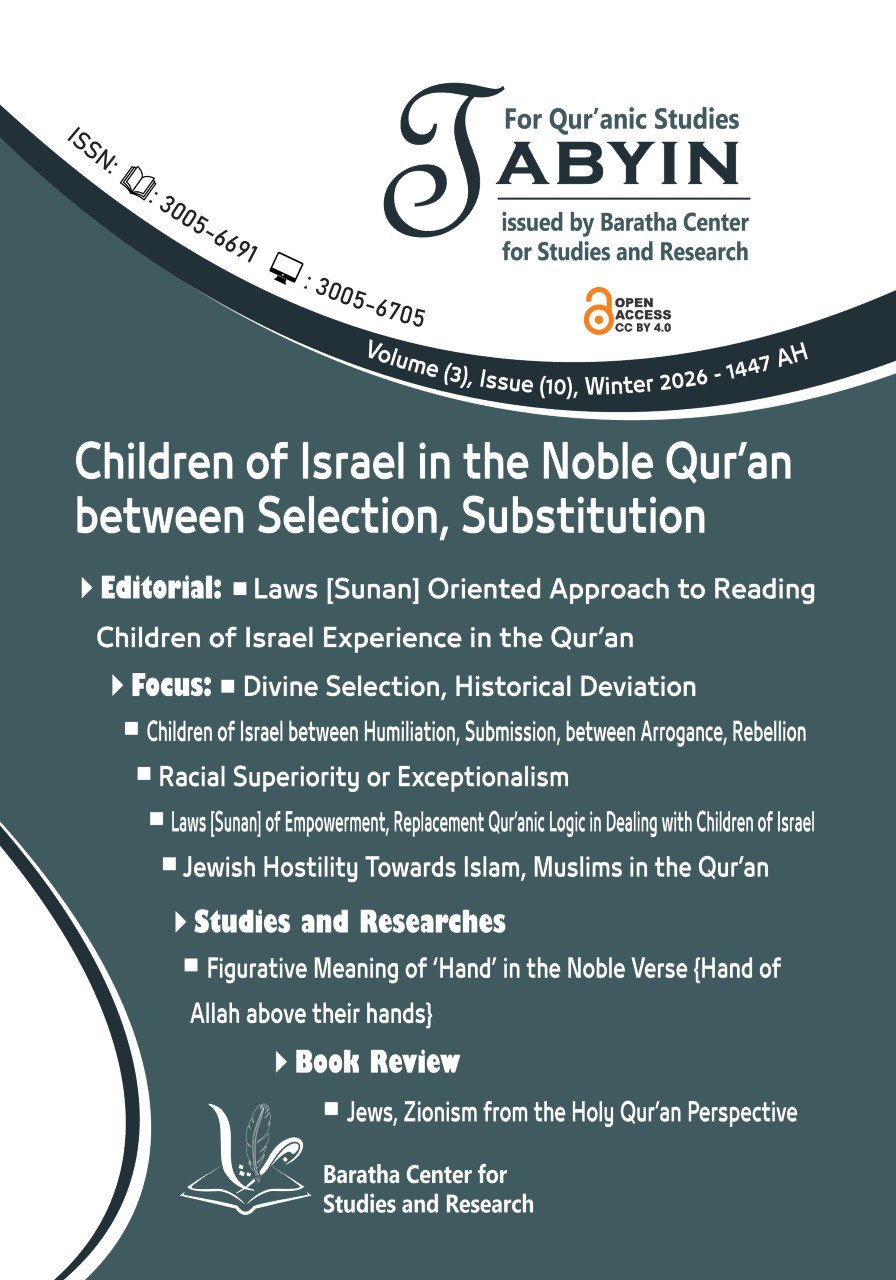
Rather, it points to broader Sunnah- based patterns governing the relationship between revelation and society, as well as between the prophetic message and the history. The Qur'an invokes the experience of the Children of Israel as a human case, through which key moral and historical dynamics can be explored, such as the principles of divine selection, the conditions that lead to deviation, the processes of moral and social decline, and the laws of replacement. Accordingly, the study of the Children of Israel moves beyond the limits of religious or political polemics and becomes an entry point to understand the historical trajectories of societies. It highlights how revealed messages may operate as sources of ethical and civilizational renewal, or conversely, how they may be reduced to instruments of justification when their moral foundations are lost.
It explains that, from an Islamic perspective, Allah's selection is based on piety, good actions, and commitment to the covenant, rather than being a permanent racial preference. Allah, Almighty, granted the Children of Israel prophethood, the scriptures, blessings, and power to guide them, but their repeated errors, such as altering scriptures, breaking promises, worshiping the calf, and killing prophets,led to the loss of their status and resulted in Allah's anger. It also challenges the idea of the "chosen people," highlighting that true honor comes from faith and actions, not lineage. It points out that the highest form of selection is seen in the mission of Prophet Mohammad (peace be upon him), who brought a universal, lasting message that supersedes previous ones.
The research concludes that selection is both a moral and historical responsibility, and real distinction is achieved through piety and righteous deeds, not through national identity. Therefore, it emphasizes the contradiction between divine blessings and human mistakes, and how this has shaped the fate of nations, showing that privilege is lost when religious conditions are violated according to the Qur'anic perspective of religious history.
The first section focuses on the psychological and behavioral traits derived from the Qur'anic stories, emphasizing that this characterization does not deny the existence of righteous individuals who have deviated from this framework. The second section compares these traits to what the author perceives as their reflection in contemporary Israeli behavior. The research also calls for a revision of the common mythical images of Jews, distinguishing between religious reading and exaggerated ideological analysis. The research concludes that understanding this Qur'anic perspective, as proposed, provides a broader interpretive framework for studying collective behavior within its historical and religious context, without neglecting the human complexity and the multiplicity of social and political factors that contribute to the formation and transformation of societies over time. This makes the proposed analysis a tool for understanding religious discourse and its connection to contemporary reality in a critical and balanced manner, taking both the text and history into account, and aiming for a conscious reading that avoids absolute generalization while considering the complexity of human reality and the various factors influencing societal formation.
In their literature and practices, it has shifted from a sense of divinely ordained and divinely ordained selection to one of racial privilege and guaranteed salvation in the afterlife. The Holy Qur'an addresses this misconception by acknowledging historical instances of divine favor and temporary selection granted to the Children of Israel, while simultaneously refuting the transformation of these into an exclusive right to closeness to God and salvation in the afterlife. This study will examine the Quranic stance on this claim, which many Jews have promoted and marketed throughout history, that they enjoy exclusive divine selection, necessitating perpetual superiority and guaranteed salvation solely based on lineage and affiliation. The study will demonstrate that the Holy Qur'an dismantles this claim through a comprehensive methodology.
the principle of empowerment and the principle of replacement, using the Israeli experience as a case study. It aims at exploring the Qur'anic approach to the Children of Israel, examining their rise to power (empowerment) and their eventual decline and fall (replacement). The study begins by defining these divine principles, highlighting the difference between empowerment as a test and empowerment as a reward. It then analyzes key historical moments when Allah, Almighty, granted the Children of Israel power, and how this power ultimately became a test of their faith and patience. The study also addresses the principle of replacement, explaining it as a strict law that does not favor any particular race or ethnicity.
It concludes that the Qur'anic account of the Children of Israel is not just a historical narrative, but rather a warning to the Muslim community about the dangers of falling into the same mistakes that led to their downfall and replacement.
It reveals the most important stages and transformations, which began with the prophecy of the Prophet of the End Times, the transfer of prophethood from the Children of Israel to the Children of Ishmael, until the Prophet's life in Medina [Yathrib], and the intellectual and religious debates that ensued, followed by military clashes, and the subsequent general Qur'anic warning against the hostile behavior of the Jews. The study also examines the subsequent ramifications of this animosity after the death of the Prophet (peace be upon him and his family), particularly concerning the phenomenon of "Isra'iliyyat" (Israeli traditions) and their negative impact on certain aspects of Islamic heritage. It concludes by exploring the Qur'anic consequences related to the corruption of the Children of Israel on Earth, and the ultimate outcome of the conflict between Muslims and Jews, which will culminate in the re-entry into the Al-Aqsa Mosque and the dismantling of the Jewish state in Palestine.
This research discusses the opinions of interpreters, following a descriptive-analytical approach, regarding the figurative meaning of the word "hand" in the verse: {The Hand of Allah is above their hands} [al-Fateh, verse: 10]. Given that Islamic theology affirms that Allah is free from bodily attributes, the main question in this research is: What is the figurative meaning of the word "hand" in this verse, and what did Allah, Almighty, mean by it? The interpreters have presented various opinions regarding the figurative meaning of the word "hand," with up to eighteen different interpretations. Al-Zamakhshari was the first to interpret it as the hand of the Messenger of Allah (peace be upon him). However, this research critiques al-Zamakhshari's view, arguing that it is incomplete, and proves that the figurative meaning of "hand" in this verse refers to the "hand of Allah's covenant.
The author analyzes the negative attributes ascribed to Jews, classifying them into religious, social, economic, and political categories, based on a broad interpretive reading of the verses. He also compares these attributes with the characteristics of the contemporary Zionist movement, to confirm the existence of identity-based, intellectual, and behavioral similarities between them. He discusses the concept of identity as a key to understanding the historical and political conflict, then moves on to concluding practical principles for policy towards the Zionist entity, inspired by the Prophet's (peace be upon him) approach in dealing with the Jews of Medina. He presents steps that begin with dialogue and warning, and end with confrontation when necessary, and concludes with a critical evaluation that highlights the strengths related to comprehensiveness and documentation. He also refers to methodological observations about the breadth of the subject and the need to deepen the analysis and organize the results, in a way that enhances the academic understanding of the relationship between the Qur'anic text and contemporary political reality. In addition to that, he emphasizes that the book seeks to link religious interpretation with political application, within an integrated theoretical framework that focuses on identity as a guiding factor for collective behavior, policy formulation, and the determination of strategic positions.



Comments