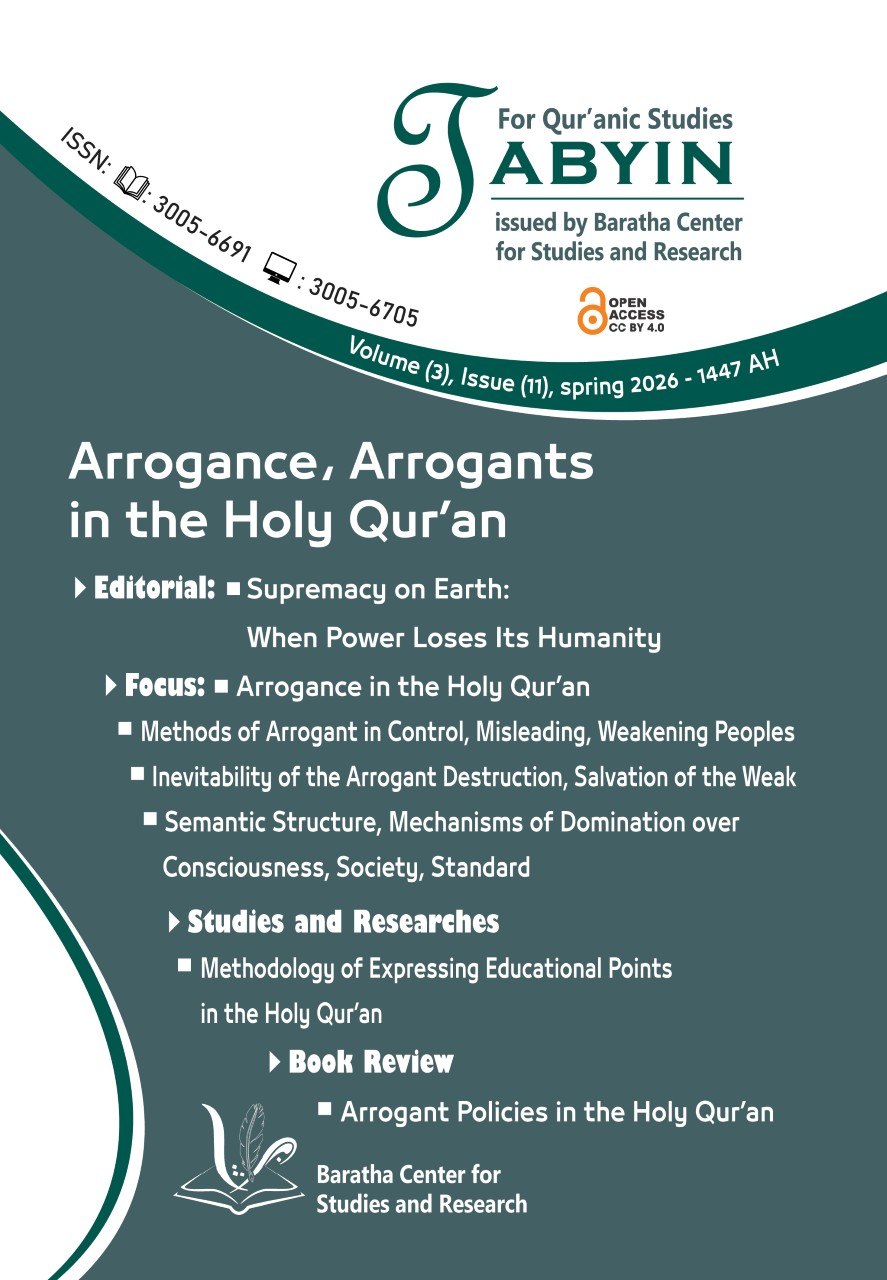
Tabyin Eleven Issue: Arrogance، Arrogants in the Holy Qur'an
Work Team :
General Supervisor : Sheikh Jalal al-DinAli Al-Sagheer
Editor in chief : Dr. Mohammad Mahmoud Mortada
Translators - English : Lina al-Saqer
Managing Editor : Dr. Fadel Madab Al-Masoudi
Managing Director : Dr. Ali mohammad jawad fadlollah
Translators - Persian : Dr. Mohamad Firas Alhelbawi

Research Summaries
The issue of arrogance in the Holy Qur'an is not merely an isolated individual behavior; rather, it constitutes one of the pivotal themes that reveal the very nature of human conflict throughout history.
The Qur'an views the arrogant oppressor as an entity bent on imposing hegemony, reshaping consciousness, and entrenching systems of oppression, corruption, and deviation. Consequently, the figure of the arrogant oppressor recurs throughout Qur'an ic narratives as a perpetually renewing archetype, one that ceaselessly reproduces itself through ever-changing tools, guises, and names.
From this, it becomes clear why the Holy Qur'an often initiates the struggle for guidance by exposing the psychological and intellectual structure of arrogance before addressing its political or economic manifestations; for the very root of arrogance lies in a human being’s stance toward Truth itself. Allah Almighty states: {146I will turn away from My signs those who are arrogant upon the earth without right} [Al-A'raf, verse: 146].
Thus, arrogance here is far more than a mere sense of superiority. Rather, it is a state of existential blockage, which renders a person incapable of perceiving the Truth, even when it is plainly evident. Indeed, within the Qur'anic context, arrogance is inextricably linked to spiritual blindness, the deliberate suppression of insight, and rebellion against the very imperatives of divine guidance.
Perhaps the most prominent model the Qur'an presents in this context is the evil [Iblis]. He was neither ignorant of Allah Almighty nor a denier of His existence; rather, he fell when he made his own self the sole criterion for truth, declaring: {I am better than him} [Al-A'raf, verse: 12]. From that very moment, arrogance became a foundational moment in the history of human deviation; for the problem lay not in knowledge, but in a will that refused to submit to the Truth. The Qur'an reveals that the most dangerous forms of deviation stem from an inflated ego, a condition that renders an individual incapable of acknowledging anything that threatens his privileges or his self-image.
This phenomenon expands in the Qur'anic models from an individual attitude into an integrated civilizational structure. Pharaoh represents the model of a state of arrogance and domination that monopolizes both power and narrative, in a moment of appropriating collective consciousness. The arrogant ruler becomes an absolute authority that dictates how people think and perceive the world, so that arrogance itself becomes a form of occupation of human perception. For this reason, the Qur'an consistently links arrogance with corruption, since the arrogant seek to reshape values and concepts in ways that ensure the perpetuation of their system of domination.
The significance of revisiting the concept of arrogant domination in our contemporary world lies in the fact that, while the tools of control are undergoing massive transformations, their essence remains unchanged. Today, the arrogance asserts its presence through media, economics, and technology, as well as through the reshaping of collective consciousness and the designing of global cultural norms. Hegemony has become increasingly adept at infiltrating minds, steering and even manufacturing desires. Consequently, the Qur'anic approach to the arrogance emerges as profoundly relevant, owing to its capacity to expose the deep-seated roots of domination, regardless of the forms it may assume.
Furthermore, the Qur'an presents the the oppressed as the primary force for change. Allah Almighty’s says: {And We desired to bestow a favor upon those who were oppressed in the land and to make them leaders}
[Al-Qasas, verse: 5].
Thus, the Qur'an does not merely describe reality; rather, it establishes a liberator consciousness that opens up a historical horizon, one that transcends the immediate moment of oppression to embrace a project of empowerment and justice.
First: Arrogance in the Qur'an, From Individual Morality to Civilizational Structure
When the Qur'an speaks of arrogance, it presents a complex concept that reveals the nature of the deviation that occurs when an individual or a group becomes a closed center of truth, power, and meaning. In the Qur'anic perspective, arrogance is an existential stance toward the Truth, manifested in the refusal to submit to Allah, Almighty and in attempts to subjugate others to the will of the arrogant person and their system.
From this, we understand why the Qur'an links arrogance with turning away from Allah signs. Allah, Almighty, says: {Indeed, those who are arrogant toward My worship will enter Hell humbled} [Ghafir, verse: 60]. The arrogance, then, is the refusal of servitude to Allah, refusal to recognize a higher authority beyond the self, because the arrogant, in the Qur'anic view, strive to be the ultimate reference, independent of any higher standard.
The Qur'an emphasizes the cognitive dimension of arrogance even before its behavioral aspect. The problem is not always a lack of knowledge, but the will that refuses to surrender to the truth. Allah says of some of the People of the Book [Ahl al-Kitab]: {They denied it while their own selves were convinced of it, out of injustice and pride} [Al Namel, verse: 14]. Here, the supremacy is the arrogance that turns knowledge into a tool for contesting the Truth, rather than a means of approaching it. One of the gravest warnings of the Qur'an is that a person may know the truth yet reject it, because accepting it threatens their position, privileges, or self-image.
The arrogance represents a mental framework that shapes a particular worldview. The arrogant person sees themselves as the center of existence, others as subordinate, and the Truth as subject to their interests rather than as a standard to which they must adhere.
The Qur'an also presents arrogance as a collective phenomenon that produces complete social and political systems. For instance, Pharaoh established an arrogant structure, which reshaped society on the principles of domination, fragmentation, and control. Allah, Almighty, says: {Indeed, Pharaoh exalted himself in the land and divided its people into sects} [Al-Qasas, verse: 4]. This supremacy is a process of social engineering based on segregation, weakening, and creating dependence, illustrating the Qur'anic depiction of the system that arrogance generates.
It is noteworthy that the Qur'an employs the term "al-mala" (the elite or the prominent figures, or the leaders) in many prophetic narratives. For instance, Allah, Almighty, says: {The leadrers of his people who were arrogant said…} [Al-Araf, verse: 88]. Here, the arrogance is the act of a class that possesses influence, authority, and the power to shape collective consciousness. In the Qur'an, "al-mala" represents the structure that guards hegemonic interests, those who, in most cases, opposed the prophets, because the divine message did not merely challenge corrupt beliefs but also threatened privileges built on injustice and exploitation.
Hence, the Qur'an consistently links arrogance with the attempt to dominate human perception. The arrogant seek to occupy consciousness itself. From this perspective, we understand the statement of Pharaoh in the holy verse: {I do not show you, except only what I see} [Ghafir, verse: 29].
This represents the peak of cognitive arrogance, where the ruler or the dominant class becomes a reference point that dictates to people how to think, what should be seen, understood, or believed. Here, the tyranny is no longer merely political oppression; it becomes the shaping of perception and the remolding of collective consciousness.
In this context, the danger of contemporary arrogance becomes clear.
The tools of control are no longer limited to military power or direct coercion; they now rely on the construction of meanings, images, and narratives. The modern hegemony has become more capable of penetrating minds through media, culture, and technology, shaping public opinion. Here, the depth of the Qur'anic perspective is evident: the essence of arrogance remains constant, even if its tools change. In every era, the arrogant seek to monopolize both power and truth.
The Qur'an does not merely condemn arrogance on moral grounds; it presents it as a civilizational threat to human dignity. When the arrogant refuse to submit to Allah, they ultimately demand submission from others, giving rise to all forms of political, economic, and cultural enslavement. Therefore, the prophets’ struggle with the arrogant represents a conflict between a project of human liberation and a project of transforming humans into subjects of hegemonic systems.
By presenting examples of arrogance throughout history, the Qur'an aims to cultivate awareness capable of recognizing arrogance in its renewed forms. The arrogant may be an individual, a state, or a media, economic, or cultural system. Yet the defining feature remains the same: the rejection of truth when it threatens their dominance and the attempt to reshape humanity to serve the continuation of their control. Understanding arrogance from the Qur'anic perspective is essential to comprehending the nature of global struggles and how power, when separated from guidance, can become a project of corrupting both humanity and history.
Second: The Arrogant in Major Qur'anic Models
The Qur'an presents the arrogant as illustrative models that reveal the nature of deviation when power transforms into a tool of deification and domination. The Qur'anic narratives are not built merely on storytelling; they aim to uncover recurring patterns across history. In the Qur'an, the arrogant represent a psychological and civilizational structure that can be reproduced whenever conditions of tyranny and absence of awareness prevail.
The Qur'an often begins with the root of arrogance: Iblis (the evil). Iblis did not lack knowledge of Allah, nor did he fail in worship, yet he fell when the self became the center of truth, saying: {I am better than him; You created me from fire and him from clay} [Al-Araf, verse: 12]. This verse exposes the deep structure of arrogance: measuring truth by the standard of the self, rather than measuring the self by the standard of truth. Iblis’ problem was not intellectual but existential; he could not tolerate someone else being honored above him.
Iblis arrogance illustrates the danger of superior comparison that produces contempt and exclusion. The Qur'an then moves to the clearest political model of arrogance: Pharaoh. If Iblis represents primordial existential arrogance, Pharaoh represents the transition of arrogance into a full-fledged governing system. Allah, Almighty, says: {Indeed, Pharaoh exalted himself in the land} [Al-Qasas, verse: 4]. This "supremacy" signifies a state in which the ruler sees himself above the people, above truth, and above history. Hence, he declares: {I am your most exalted lord} [An-Naziat, verse: 24]. This is the apex of arrogance, when authority transforms into a claim of absolute reference.
Yet the Qur'an does not focus solely on Pharaoh’s personal tyranny; it reveals the mechanisms he used to construct dominance. While he ruled with force, he also sought to control collective perception. He told his people: {I do not show you, except only what I see} [Ghafir, verse: 29]. The arrogant here seeks to monopolize vision itself, rendering people unable to think beyond the limits imposed upon them. Thus, Pharaoh’s model in the Qur’an appears as a project of reshaping consciousness, not merely a political system of oppression.
The Qur'an links Pharaoh’s arrogance to the production of the weak and subjugated: {He subjugates a group among them, slaughtering their sons and sparing their women} [Al-Qasas, verse: 4]. The arrogance always requires the creation of psychologically and socially broken groups to sustain control. The arrogant fears not only the military power of the weak but also their awareness, will, and capacity to reclaim their humanity.
The Qur'an presents another equally dangerous model: Qarun (Korah). If Pharaoh represents the arrogance of authority, Qarun represents the arrogance of wealth. Allah says: {Indeed, Qarun was from the people of Moses, but he rebelled against them, and We gave him of treasures whose keys would burden a band of strong men} [Al-Qasas, verse: 76].
Notably, rebellion here is not linked to poverty or deprivation, but to abundance when divorced from humanity. Wealth for Qarun became a source of complete self-sufficiency, prompting him to claim: {I was only given it because of knowledge I have} [Al-Qasas, verse: 78].
This mindset deifies the self and nullifies the social and ethical dimension of blessings.
The Qur'an shows that economic arrogance transforms wealth into a tool of superiority and domination, reshaping values. People were drawn to Qarun's displays, saying: {Oh, would that we had what Qarun was given!} [Al-Qasas, verse: 79]. The arrogance asserts itself not only through force but also through spectacle.
The Qur'an does not limit itself to individual models but repeatedly addresses "al-mala", the collective elite that nurtures arrogance. In confronting the prophets, the first opponents were often influential classes who felt their privileges threatened. Allah, Almighty, says: {And the eminent ones among his people who disbelieved and denied the meeting of the Hereafter and We had made them enjoy worldly life} [Al-Mu’minun, verse: 33]. Their worldly comfort creates a psychological structure that binds humans to their interests and generates fear of any change threatening the system of privilege.
The Prophets faced entire networks of political, economic, and cultural interests. This explains why resistance to divine revelation often came from the most influential forces: the message challenged structures built on injustice and exploitation.
The Qur'an also presents the Quraysh in response to the prophetic message as another dimension of arrogance. The Quraysh did not doubt the truthfulness of the Prophet (peace be upon him): {Indeed, they do not deny you, but the wrongdoers deny the signs of Allah} [Al-Anam, verse: 33]. The problem ran deeper than intellectual disagreement; Islam threatened the tribal, economic, and symbolic structures the Quraysh had built around the Kaaba, trade, lineage, and influence.
Quraysh’s arrogance stemmed from fear of losing historical centrality, saying: {Has He appointed gods besides Him? Indeed, this is a curious thing} [Sad, verse: 5]. Their rejection was not only of the message's content but also of the societal transformation it would bring.
The common thread among all these models is that arrogance often begins with an inflated self but does not remain confined to the individual; it transforms into a project of subjugating others and creating systems that preserve privilege through force, fear, spectacle, or control of perception. The Qur’an presents these figures as a perpetual warning of humanity’s potential to reproduce Pharaonic, Qarunian, and Iblis-like arrogance in new forms.
The most dangerous aspect of arrogance is what it does to the arrogant themselves: it gradually isolates them from truth until they become prisoners of the illusion of absolute power. Hence, the end of the arrogant in the Qur’an is always a dramatic downfall revealing the fragility of power when severed from truth. Pharaoh drowned, Qarun was swallowed by the earth, and Iblis became a symbol of eternal curse. Arrogance, no matter how victorious it appears, remains fundamentally a project at odds with Allah's laws and history, carrying the seeds of its own destruction from the very beginning.
Third: Psychological, Cognitive Mechanisms of Arrogance
The Qur'an does not limit itself to describing the overt actions and crimes of the arrogant; rather, it delves into the psychological and cognitive structures that generate arrogance in the first place. This is because the Qur'anic discourse seeks to deconstruct the roots that render a person susceptible to becoming arrogant or compliant with systems of arrogance. The Qur'an approaches arrogance primarily as a distortion of perception before it manifests as a deviation in behavior, and as a disruption in the relationship with truth before it is merely a tendency toward domination.
One of the first insights the Qur'an offers in this context is that arrogance often begins with the inflation of the self, until it becomes a reference higher than truth itself. Allah says: {Have you seen the one who takes his desire as his god?} [al-Jathiya, verse: 23]. Here, the desire (hawa) points to a moment when the self becomes the ultimate criterion for judgment and evaluation.
The Qur'an links the arrogance to the "following of desire," because when desire becomes the center of consciousness, it impairs the ability to perceive objectively. The person no longer seeks truth so much as what confirms the self and preserves self-interest. This explains why many of the arrogant figures mentioned in the Qur’an recognized the truth of the prophets yet rejected them. Allah says: {Those to whom We gave the Scripture recognize him as they recognize their own sons.} [al-Baqarah, verse: 146]. The problem was not a lack of knowledge but a resistance to truth when it threatened existing psychological or social structures.
Among the most dangerous psychological mechanisms revealed by the Qur’an is the fabrication of an illusion of superiority. The arrogant always need to construct an imagined self-image as superior, more rightful, more knowledgeable, or stronger than others. For this reason, Satan’s discourse is based on comparative arrogance: {I am better than him.} [al-Araf, verse:12].
It is an integrated logic based on turning difference into a justification for superiority, and from this arise various forms of racism, classism, and cultural and civilizational colonialism; as the arrogant person sees the other as material for domination or subservience, not as a partner in humanity.
Building on this, one can discern the deep cognitive dimension of arrogance in the Qur’an. The arrogant attempts to redefine truth itself. Pharaoh’s declaration exemplifies this: {I do not show you except what I see.} [Ghafir, verse: 29].
Hence, the Qur’an frequently discusses “adornment” and “hindrance from the path,” because arrogance requires the distortion of awareness to persist. Allah says: {But Satan adorned their deeds for them.} [al-Naḥl, verse: 63]. The arrogant rarely see themselves as unjust; instead, they reproduce a discourse that justifies their behavior, granting it moral, civilizational, security, or religious legitimacy. The danger of arrogance becomes apparent when it transforms into the capacity to invert concepts themselves: oppression becomes protection of the system, occupation becomes the spread of civilization, and exploitation becomes the defense of freedom.
Another perilous psychological mechanism revealed by the Qur’an is fear of losing privileges. The arrogant is not perpetually confident as they may appear; rather, they harbor a deep-seated fear of the collapse of their status. Accordingly, resistance to the prophets was always linked to concerns over authority, wealth, or influence. Allah, Almighty, says regarding Pharaoh’s council: {Will you leave Moses and his people to corrupt the land and forsake you and your gods?} [Al-Araf, verse: 127]. They perceive liberation as corruption because any new awareness threatens the structures that preserve their privileges.
The arrogance often thrives on cultivating collective fear. The arrogant must convince people that their continued dominance is necessary for stability and that any attempt at liberation will lead to chaos or collapse. Propaganda has thus historically been one of tyranny's most crucial tools. Domination does not rely solely on force; it relies on managing collective perception and producing beliefs that make oppression appear natural or necessary.
The Qur'anic approach is particularly profound in understanding contemporary forms of arrogance. Today's world is governed not only through military power but also through control over perception, the creation of mental images, and the reshaping of desires, fears, and values. Media, digital platforms, cultural industries, and artificial intelligence have become integral to this grand battle over consciousness. The modern arrogant does not always need to occupy land as long as they can occupy minds.
What is most perilous today is not merely overt arrogance but the kind that infiltrates consciousness to become part of one's very way of thinking. Individuals may become instruments within a system of domination while believing they are exercising full freedom. This underscores the Qur'an's emphasis on liberating perception before liberating reality, for the true struggle begins with restoring humanity’s capacity to perceive truth outside the noise manufactured by forces of arrogance.
In deconstructing the psychological and cognitive structures of arrogance, the Qur'an aims not only to warn against tyrants but also to alert humans to their internal susceptibility to arrogance. Every moment in which desire becomes a higher reference than truth, every moment a person despises others or justifies injustice to preserve a privilege, constitutes the germination of arrogance within the self.
Fourth: Arrogance in Contemporary World, Transformations in Tools, Constant Essence
When the Holy Qur'an presents models of arrogant people throughout history, it aims to cultivate an awareness capable of recognizing the ever-evolving forms of arrogance. Arrogance is a persistent logic that reproduces itself whenever the tools of hegemony and the will to control are available. The danger of contemporary arrogance lies in its complexity and flexibility compared to older models. It has developed its tools to keep pace with global transformations, while its essence remains based on the monopolization of power, meaning, and truth.
The arrogance in the past was characterized by directness and explicitness, but today it has become more adept at concealing itself behind humanitarian, economic, and cultural slogans. Hegemony is now exercised in the name of freedom, nations are reshaped in the name of democracy, and countries are destroyed under the banners of "protecting the world order" or "combating terrorism." This highlights the depth of the Qur'anic approach, which reveals that arrogance is measured by the structure it produces: a structure of control and subjugation, and the reshaping of humanity to serve centers of power.
When the Qur'an speaks of the arrogant, it always links them to the attempt of "supremacy on earth." Allah Almighty says: {That is the home of the Hereafter, which We assign to those who do not desire exaltation upon the earth or corruption} [Al-Qasas, verse: 83]. The "supremacy" here does not simply mean material superiority, but rather the will to dominate that leads some powers to see themselves as guardians of the world, entitled to determine the destinies of peoples, cultures, economies, and even moral values.
Perhaps the most prominent transformation of modern arrogance lies in the shift from direct military occupation to soft power. Global media, communication platforms, cultural industries, and entertainment have become part of the battle for control of consciousness.
One of the most dangerous tools of contemporary arrogance is the manufacturing of collective consciousness. Humans today live amidst a massive influx of images, discourses, and information that not only convey reality but also reproduce it according to the interests of dominant powers.
The media becomes a tool for redefining criminal and victim, resistance fighter and terrorist, occupier and civilized person. When the Qur'an speaks of "beautifying deeds" or "obstructing the path," it reveals a profound mechanism that remains active today, even if the means and tools have changed.
The Qur'an does not separate arrogance from extravagance. Allah Almighty says: {And when We intend to destroy a city, We command its affluent ones, but they defiantly disobey therein} [Al-Isra, verse: 16]. The extravagance is a civilizational condition that results in detachment from values and transforms humanity into a consumerist being devoid of meaning. Thus, modern arrogance does not always require direct repression, as control can sometimes be achieved by immersing individuals in consumerism and entertainment, and reshaping their desires to the point where they become incapable of thinking outside the imposed system.
One of the most dangerous manifestations of contemporary arrogance is cultural hegemony. Major powers seek to export their conceptions of humanity, family, sexuality, freedom, religion, and meaning. Media, education, art, and digital platforms are thus transformed into tools for re-engineering human identity globally. Therefore, the contemporary struggle is a struggle over the very definition of humanity itself.
In this context, technology and artificial intelligence stand out as among the most dangerous new arenas of conflict. These tools, despite their immense potential to serve humanity, could be transformed into unprecedented means of surveillance, control, shaping perception, and manufacturing public opinion. The most dangerous aspect of contemporary arrogance is that it no longer merely imposes obedience by force, but seeks to mold individuals who willingly embrace the values of dominance and reproduce them within their consciousness and daily behavior.
Despite the tools, technologies, and soft and hard power at its disposal, this arrogance remains an extension of the ancient logic, which prophets (peace be upon them) confronted throughout history: the logic of supremacy on earth, monopolizing truth, and subjugating humanity to systems of power. Therefore, the Qur'an does not present the confrontation with arrogance as a circumstantial battle tied to a specific time or place, but rather as an ongoing struggle between a project striving to liberate humanity for Allah and a project aiming to transform humanity into a subservient entity within systems of dominance, regardless of their changing names and slogans.
Fifth: The Oppressed in the Qur'an, From Victim to Historical Agent
If the Qur'an reveals the nature of arrogance, its mechanisms, and its psychological and civilizational structures, it does not, conversely, present the oppressed merely as helpless victims trapped in a cycle of subjugation without horizons. Rather, it presents them as a central force in the movement of history and the laws of transformation. The Qur'an regards oppression as a condition that can be transformed when human beings regain awareness, will, and connection to Allah. Thus, the discussion of the oppressed in the Qur'an is not one of pity, but of a project for historical, ethical, and civilizational liberation.
The Qur'an clearly distinguishes between "weakness" and "oppression." Weakness may be a natural state related to one’s abilities and capacities, whereas oppression is a process imposed upon an individual or group with the aim of stripping away their will and turning them into instruments within a system of domination. Hence, Allah says about Pharaoh: {Indeed, Pharaoh exalted himself in the land and made its people into factions, oppressing a group among them} [Al-Qasas, verse: 4]. The oppression is not an inherent characteristic of the Israelites; it is a deliberate policy aimed at producing a psychologically and socially broken group, making them easy to control.
The Qur'an reveals that arrogance seeks to destroy the psychological structure of the oppressed by spreading fear, undermining self-confidence, and turning people into beings devoid of will. One of the most dangerous effects of domination is the creation of a mindset of helplessness and submission, where oppression becomes part of daily consciousness.
However, the Qur'an rejects the idea of turning the oppressed into a permanent negative identity. The pivotal verse in this context states: {And We desire to bestow Our favor upon those who were oppressed in the land and make them leaders and make them inheritors} [Al-Qasas, verse: 5].
This is one of the Qur'an's clearest expressions of its philosophy of history; it does not merely speak of ending injustice but of transforming the oppressed from a position of subordination to one of leadership.
The Qur'an envisions the oppressed as ethical and civilizational actors capable of rebuilding history based on justice.
In the Qur'anic vision, liberation begins with consciousness before weapons and with reclaiming dignity before reclaiming authority. This is why Moses (peace be upon him) did not first build an army, but rather rebuilt awareness within the oppressed community. A person convinced of their own helplessness cannot be liberated even if they possess instruments of power, because true defeat begins within the self.
The Qur'an repeatedly calls for psychological resistance to the arrogant. Allah says: {So do not weaken and do not grieve} [Al-Imran, verse: 139]. This is a call to resist the internal defeat that systems of domination constantly seek to produce. Arrogance always relies on convincing others that it is an invincible force, that resistance is futile, and that the world cannot change. The first victory of the oppressed is to shatter the illusion of absolute arrogance in their consciousness.
The Qur'an does not link empowerment to numbers, wealth, or material power alone, but to faith, awareness, and perseverance. Allah says: {How many a small group has overcome a large group by permission of Allah} [Al-Baqarah, verse: 249]. The Qur'anic awareness redefines strength itself; true power lies in insight, patience, and the ability to remain steadfast in the face of attempts at subjugation.
In this context, the value of "patience" in the Qur'an emerges as an act of resistance rather than a passive state. Qur'anic patience is the ability to remain firm and not collapse under psychological, political, or civilizational pressure. Hence, Allah says: {And We made of them leaders guiding by Our command when they were patient} [Al-Sajda, verse: 24]. The leadership here is linked to patience because the struggle for liberation requires the capacity to resist discouragement, fear, and deception.
It is also noteworthy that the Qur'an reveals the responsibility of some oppressed individuals for the continuation of oppression when they become complicit in systems of domination through fear, subordination, or justifying injustice. Allah says: {Indeed, those whom the angels take in death while they are wronging themselves, they will say, ‘What were you doing?’ They will say, ‘We were oppressed in the land} [Al-Nisa, verse: 97]. The Qur'an does not allow oppression to be an excuse that entirely removes moral responsibility; it distinguishes between those who were truly subjected to coercion and those who surrendered to it, thus perpetuating it.
In the Qur'anic vision, the liberation is not merely a political shift but a reconstruction of the human being. The Qur'an does not aim to replace one tyrant with another but to establish a society founded on justice and humility on earth. When the oppressed inherit the land, they should not reproduce Pharaoh-like domination but rather become bearers of an ethical mission that preserves human dignity.
In the contemporary world, this Qur'anic vision is particularly significant, as many peoples today experience multiple forms of political, economic, cultural, and media oppression. Nations are stripped of their resources, their consciousness reshaped, and driven toward losing trust in their history, identity, and ability to rise. The most dangerous form of modern oppression is not poverty alone, but convincing people that they are inherently powerless and that global domination is an immutable destiny.
When the Qur'an speaks of the oppressed, it does not instill a victim mentality but builds a consciousness of mission. Therefore, the true oppressed are those who have not lost their humanity despite oppression and remain capable of recognizing truth, holding fast to it, and resisting absorption into the systems of arrogance. In this vision, great empires do not always make history; rather, small groups endowed with insight, will, and perseverance can break the logic of domination and reopen the path toward freedom, justice, and guidance for humanity.
Sixth: Towards Contemporary Qur'anic reading to Confront Arrogance
The most serious threat to the major Quranic concepts is their transformation into mere sermons divorced from the dynamics of reality and history. Discussing arrogance in the Qur'an is incomplete simply by describing the arrogant or invoking past examples. Rather, it necessitates a contemporary reading that reveals the structure of arrogance in the modern world, understands its new tools, and restores the Quran's liberating function as a book that shapes consciousness and reshapes humanity in the face of all forms of domination and hegemony.
What the nation needs most today is to move beyond a reductionist reading of arrogance as merely a political label or a mobilization slogan. Arrogance in the Qur'an is far deeper than can be confined to a single state, geographical area, or temporary event; it is a comprehensive logic based on the deification of power, the monopolization of truth,
and the perpetuation of subservience within systems of hegemony.
Therefore, confronting arrogance begins with rebuilding an awareness capable of understanding how hegemony operates within culture, media, the economy, education, and daily life.
Therefore, contemporary Qur'anic readings must dismantle the hegemonic discourse that cloaks domination in glittering moral and humanitarian slogans. Many projects of control today are marketed under titles such as "defending democracy," "protecting human rights," or "maintaining global security," while in essence they practice forms of subjugation, exploitation, and control over peoples, resources, and cultures. Hence, the importance of the Qur'anic approach in revealing the underlying structures that produce injustice, corruption, and supremacy on earth.
In this context, it becomes essential to restore the centrality of Qur'anic concepts in understanding contemporary reality. The Qur'an exposes the civilizational structures that produce tyranny and oppression. Concepts such as arrogance, oppression, corruption, luxury, and tyranny are profound analytical tools for understanding the movement of history, society, and power.
One of the most serious contemporary problems is that some societies may succeed in achieving political liberation while remaining culturally and psychologically subjugated by systems of domination. A nation may reclaim its land but lose its consciousness, or it may gain political autonomy while remaining captive to the intellectual and value-based standards imposed by others. Therefore, the Qur'an emphasizes the liberation of the individual from within, because civilizational defeat often begins when a person loses faith in their identity, values, and capacity to create meaning.
Building cultural and moral immunity is a fundamental pillar in confronting arrogance. A person who loses their moral compass is easily manipulated, regardless of their material resources. Hence, the importance of connecting generations to the Qur'an as a book of awareness, action, and liberation.
Returning to the Qur'an is returning to the balance that enables a person to see reality clearly, amidst the entanglement of discourses, images, and interests. The Qur'an reveals that arrogance, no matter how technologically or media-wise advanced it becomes, remains based on the illusion of absolute power and perpetual supremacy. Therefore, the Qur'an constantly reminds us of the inevitable downfall of tyranny, no matter how cohesive it may seem, in accordance with the Almighty’s words: {And such days We alternate among people} [Al Imran, verse: 140].
The contemporary Qur'anic reading aimed at confronting arrogance seeks solely to establish a project of awareness that restores to humanity its inner freedom, its capacity for discernment, and its ability to resist the allure of power.
Ultimately, the Qur'anic message remains clear throughout the ages: that humanity's true struggle is not only against an external oppressor but also against every internal tendency to be dazzled by power, to submit to falsehood, or to elevate the self to the status of the center of truth. Therefore, the Qur'an does not merely dismantle idols of stone, but also seeks to dismantle idols of consciousness: for true liberation begins when humanity realizes that dignity is not derived from submission to the arrogant, but from servitude to God alone.
In conclusion, it should be noted that the research presented in this issue is structured as follows:
The "Focus" section addressed the following studies:
-Arrogance in the Holy Qur'an: Study of Natures, Types.
-Methods of Arrogant in Control, Misleading, Weakening Peoples: Qur'anic Models.
-Inevitability of the Arrogant Destruction, Salvation of the Weak: Qur'anic Sunnah Study.
-Arrogance in the Qur'anic Vision: Semantic Structure, Mechanisms of Domination over Consciousness, Society, Standard.
While in the section of "Qur'anic Studies, Research", it was dedicated to explain: "Methodology of Expressing Educational Points in the Holy Qur'an: "Al-Hujurat" as Model."
-In the "Reviewing a Book" section, we will read "Arrogant Policies in the Holy Qur'an."
Thus, we hope that this issue will contribute to establishing a conscious Qur'anic reading that redirects the discussion towards values, liberates man from closed narratives, and establishes a civilizational awareness that makes the Qur'an a source of guidance in a troubled world, in accordance with the Almighty’s saying: {Indeed, this Qur'an guides to that which is most upright.} [Al-Isra, verse: 9].
Allah is the One who grants success to the straight path.
This research examines the phenomenon of arrogance as a recurring social structure in the Qur'anic perspective, not merely isolated historical events.
It reveals the methodologies employed by the arrogant to control, mislead, and subjugate nations. Through an analysis of Qur'anic examples, the author demonstrates that the tools of arrogance utilize material and media power in a gradual process that begins with the dismantling of society, progresses through the monopolization of religious authority, the destruction of consciousness, the distortion of concepts, the exploitation of elites, and ultimately the fabrication of imaginary threats to control the masses. The research also affirms the vitality of the Qur'an as a source for analyzing contemporary social and political phenomena, emphasizing that confronting arrogance is fundamentally a battle of consciousness and meaning before it is a material confrontation.
This article examines the historical conflict between the oppressed and the oppressors from a Qur'anic perspective that aligns with the dynamics of human society.
It demonstrates the oppressors' persistent efforts to weaken the righteous and perpetuate corruption, and the inevitable divine laws that result from this. It also reveals the prevailing laws within the oppressed society and the divine promise of their empowerment and inheritance of the earth, emphasizing immutable divine laws govern this conflict. This necessitates awareness of these laws and guidance in managing the conflict and paving the way for empowerment.
Finally, the article addresses fundamental questions concerning the concepts of oppression, subjugation, and divine laws [Sunan] in the Holy Qur'an. It explores the nature, determinants, and trajectories of social laws, analyzes the most prominent prevailing laws in the societies of the oppressed and the oppressors, and examines how these can be utilized to construct a divinely ordained vision that supports confrontation and empowerment.
This research examines the concept of "arrogance" in the Qur'anic perspective as a cognitive and authoritarian structure that transcends the boundaries of individual psychological or moral states, becoming a recurring pattern in the production of hegemony and the reshaping of consciousness, society, and values.
It begins with the premise that the Qur'anic discourse presents arrogance as an interconnected semantic network, in which concepts of superiority, tyranny, transgression, arrogance, injustice, corruption, deceit, and treachery intertwine within a single framework that establishes a self-centeredness detached from the true, transcendent authority.
The research adopts an analytical approach based on studying the conceptual fields of Qur'anic vocabulary and linking them to the contextual structure of Qur'anic narratives, which serve as a revealing model of human social patterns, not merely a historical account. By analyzing Qur'anic models, particularly the Pharaonic model, the research reveals the cognitive, political, and psychological dimensions of arrogance, through studying mechanisms such as denial, rejection, cognitive tyranny, belittling societal awareness, policies of dismantling, violence, manufacturing fear, and directing desire towards the materialistic lifestyle, which leads to a disruption of the cognitive, moral, and social system.
The ultimate goal of the revelation of the Holy Qur'an is to guide people to the straight path of life and nurture them upon it.
This research aims to elucidate the most prominent educational methods in the Holy Qur'an, using a descriptive-analytical approach, with a focus on Surah Al-Hujurat, which serves as a model for moral education. This will enable the reader to comprehend these methods and their Qur'anic manifestations. The research identifies seven main educational methods: reminding, admonition and counsel, encouragement and punishment, emotional stimulation, commanding and prohibiting, presenting a good example, and storytelling, illustrating these methods through their application to Surah Al-Hujurat.
This study examines the concepts of arrogance and oppression in light of the Holy Qur'an and contemporary reality. It demonstrates that arrogance is a reprehensible trait manifested in haughtiness and rejection of truth, often linked to tyranny and disbelief, as seen in the stories of Pharaoh, the people of 'Ad, and the people of Thamud.
In contrast, the Qur'an highlights the oppressed who remain steadfast in their adherence to truth and patiently confront injustice. The Qur'anic text also distinguishes between legitimate elevation and reprehensible arrogance, warning that rebellion against Allah's commands and corruption on Earth lead to social, political, and economic destruction. It emphasizes that injustice and deceit that deprive the oppressed of their rights warrant divine punishment. These concepts extend to encompass the manifestations of modern global arrogance, which relies on distorting facts, monopolizing knowledge, keeping people ignorant, and imposing economic and cultural hegemony, exploiting the immersion in materialism. Hegemonic powers also employ violence, arrest, and military control to secure their political and strategic influence. Thus, this study presents a Qur'anic model for understanding the dynamics of hegemony and how to confront it through awareness, adherence to moral values, and the protection of the vulnerable. This makes it an analytical bridge connecting the Qur'anic perspective with the mechanisms of tyranny in our contemporary reality.
Comments