
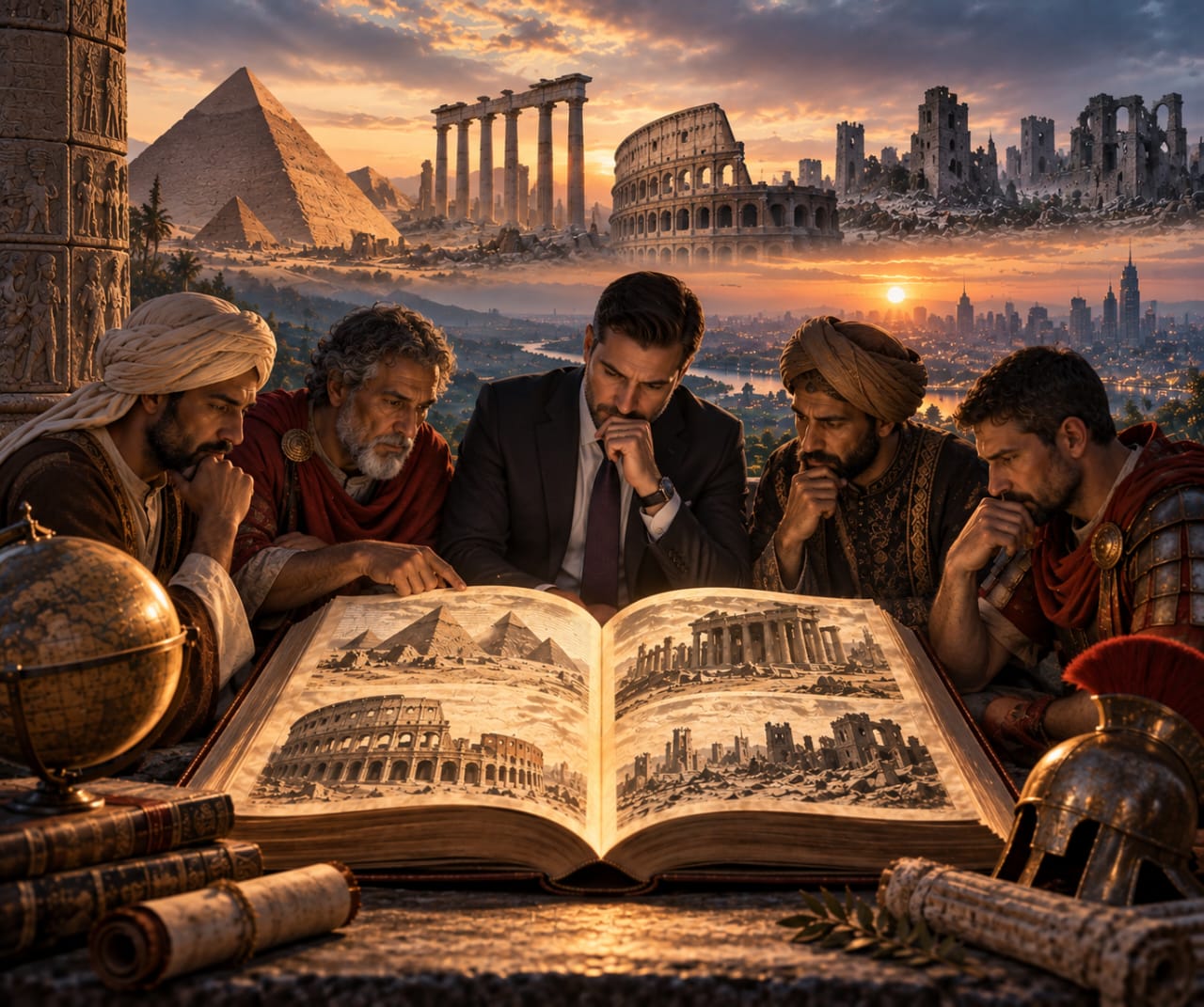

The concept of Sunnah [divine law] establishes a principle that elevates history to the status of a science, rendering the destinies of nations a subject open to comprehension and inductive analysis, governed by the logic of causality. Here, the Sunnah functions as an objective law operating with a consistency akin to the immutable and necessary laws of nature, distinct from moral exhortation that merely addresses the conscience. What befell the ancients befalls those who follow their path; the fate that struck bygone nations strikes those who emulate them. The Qur'an 's extensive recounting of the histories of past peoples serves this very purpose: stories are reiterated to anchor principles, narratives are repeated to crystallize into laws, and specific instances are revisited to reveal the overarching principles governing them. These laws operate with absolute impartiality across all nations, regardless of their creeds; the law applies to anyone who meets its criteria, without favoritism. Mere adherence to the "truth" in belief holds no sway unless coupled with justice in action. Thus, the study of these historical laws acquires objective rigor, transcending the realm of moral preaching to attain the status of law.
********************
This thesis presents a conception of the nation as an autonomous entity; it leads a life of its own and possesses a collective will that emerges from the interaction of its individuals, transcending their mere numerical aggregate, while being structured by a system of values and relationships that fuse it into a unified whole. Furthermore, it has a finite lifespan, marking the conclusion of its civilizational existence: {to every people is a term appointed: when their term is reached, not an hour can they cause delay, nor can they advance.} [Al-A'raf, verse: 34]. An individual is born and dies within a brief lifespan, whereas a nation spans successive generations, moving through a cycle of emergence, maturation, and decline. This distinction between individual time and national time establishes a philosophy that views the community as a civilizational entity possessing its own logic of life and death. This perspective reveals the true scope of "ruin": the death of a civilization precedes physical desolation, and internal decline anticipates the destruction of stone and mortar. The nation, first, loses its unifying spirit. Then it does its material edifice crumble, reflecting the decay that has already taken hold within.
At the heart of this logic, lies a moral cause that operates within the course of history much like a cause producing its effect; the Qur'an establishes that injustice is an active force driving the collapse of civilization, a genuine cause that inevitably precipitates its consequence, as stated in the Almighty's words: {And your Lord would not have destroyed the cities unjustly while their people were reformers.} [Hud, verse: 117]. Consider the precision of this formulation: destruction is linked to the state of the people within their social collective, and the criterion for survival is the rectitude of dealings and the social order. The town, characterized by reform survives, whereas one where injustice runs rampant incurs a civilizational reckoning. In essence, injustice is the misplacement of things and a disruption of the balance of relationships, a state where the vulnerable are humiliated, those in power transgress the law, and rights are squandered. In this worldview, the legislative order is inextricably linked to the cosmic order of creation; justice is a universal law that preserves social equilibrium, while injustice is an assault on that balance, triggering the reaction Allah, Almighty, has embedded within the very structure of civilization. When this imbalance becomes acute, the bonds underpinning society unravel, and the dysfunction accumulates within its fabric until the threshold of collapse is reached. Thus, desolate ruins transform into a meaningful sign: {So those are their houses, desolate because of the wrong they did; indeed in that is a sign for a people who know.} [Al-Naml, verse: 52]. The ruin becomes a sign can read it, and the letter (b), in the Arabic word (bimazalamu), which means, "because of the wrong they did", firmly binds the consequence to its cause.
*******************
At this point, the difference between this philosophy and the materialist interpretation of history becomes clear. The latter attributes the rise and fall of civilizations solely to factors of power and economics. This interpretation remains superficial, merely observing the movement of wealth, weapons, and urban development, and then taking these as the ultimate cause. The Qur'an, however, penetrates to the core that drives this surface, establishing destiny on a value-based foundation that governs both economics and power. Wealth is a tool, by which society is improved or corrupted, and power is a means by which justice is established or tyranny is spread. Moral values determine the direction of these tools. Therefore, whoever reduces civilization to its economics and power is confusing cause and effect, mistaking the effect for the cause. Material factors are merely the arena for the manifestation of moral action, which alone is the true cause of survival or demise.
This conception distinguishes between the instrument of destruction and its cause. The Qur'an mentions various physical means that were inflicted upon past nations, such as the violent wind, the cry, the earthquake, and the drowning, and attributes them all to a single moral cause, as in the Almighty’s saying: {So We seized each of them for their sin; and among them were those upon whom We sent a storm of stones, and among them were those who were seized by the cry, and among them were those whom We caused the earth to swallow up, and among them were those whom We drowned. And Allah would not have wronged them, but they were wronging themselves.} [Al-Ankabut, verse: 40]. The atural causes are instruments for carrying out divine decree, while the underlying cause remains the people's own injustice towards themselves. Thus, destruction in the Qur'an is distinguished from blind natural disasters; for although the physical event appears the same, its meaning is determined by the moral cause that brought it about. The nation creates the cause of its own demise, and then the instrument of its destruction comes to it, of the same nature as its own actions.
The Qur'an identifies the actor who practices injustice in the path of decline, which is a class that swells in the body of the nation and monopolizes wealth and influence, and turns prosperity into arrogance that disrupts justice. Allah Almighty says: {And when We intend to destroy a city, We command its affluent but they defiantly disobey therein; so the word comes into effect upon it, and We destroy it with destruction.} [Al-Isra, verse: 16].
The luxury is a condition that afflicts the elite when their privilege becomes detached from their responsibilities, giving rise to a consciousness that views this privilege as a natural right and the subjugation of others as an inevitable fate. At this stage, society loses its ability to correct its course because the very group entrusted with reform is the one benefiting from corruption. Thus, the mechanisms of self-correction are disabled, and the decline continues to its ultimate end. Perhaps the clearest example is found in the people of 'Ad, as Allah Almighty says: {As for 'Aad, they were arrogant upon the earth without right and said, "Who is greater than us in strength?" Did they not consider that Allah who created them was greater than them in strength? However, they were rejecting Our signs.} [Fussilat, verse: 15]. The material power has been transformed in their consciousness into evidence of superiority, and civilization into a pretext for tyranny, until they submitted to those who led them to their doom: {And they followed the command of every stubborn tyrant} [Hud, verse: 59].
When internal reform fails, Allah, Almighty sends messengers as an external mechanism of correction, alerting the nation to its downfall before it is too late. The message here is part of Allah's established order and law, not an event outside of it. Civilizational punishment is delayed until the warning reaches its full extent and the proof is established against the people, in accordance with Allah's words: {And We would not punish [a people] until We had sent a messenger}. In this condition, the justice of the divine order is manifested; the nation is not held accountable for negligence without warning, nor is it destroyed before it has the opportunity to return. The messenger's mission lies in restoring the lost standard to the collective consciousness, exposing the accumulated injustice that has been mistaken for justice, and calling both the oppressed and the affluent to a single scale. The nation's response to this call determines its fate. It is either a response that opens the door to salvation, or a rejection that completes the conditions for destruction.
The Qur'an reveals the centers of resistance to reform within the structure of the nation. The arrogant elite, those with prestige and wealth surrounding the ruling power, stand against the messengers in defense of a system that preserves their privileges. Allah Almighty says: {the arrogant elite among his people said to those who were oppressed, to those of them who believed} [Al-A'raf, verse: 75]. The clash here is between a reformist project seeking to restore order and entrenched interests that thrive on the imbalance of power. These elites possess the tools to influence collective consciousness, portraying the call to reform as a threat to the existing order and inciting tribalism against the advocates of justice. When the elite prevail over the voice of reform, the nation closes the last avenues for rectification, thus completing the conditions for its downfall.
The tyranny reaches its political zenith in the example of Pharaoh, as the verse describing him encapsulates the elements of decline in a single pattern. The verse states: {Indeed, Pharaoh exalted himself in the land and divided its people into factions, oppressing a group among them} [Al-Qasas, verse: 4]. This exaltation elevates the ruler above all measure, followed by a fragmentation that tears the nation's unity into warring factions, culminating in the subjugation of a particular group. Dividing society is an inherent tool of tyranny. A unified nation possesses the capacity for resistance and reform, while a fragmented nation is easily manipulated, and weakened by internal conflicts. The Qur'an concludes its description of Pharaoh with a statement that encapsulates his fate: Allah Almighty says, {Indeed, he was one of the corrupters.} [Al-Qasas, verse: 4]. Power built upon the disintegration of the social fabric and the subjugation of a segment of society carries within it the seeds of its own destruction. Pharaoh’s fate in the Qur'an is the most eloquent testament to the fact that arrogance necessitates eradication. The Qur'an links the downfall of Pharaoh to the law of the oppressed inheriting power, making the collapse of the oppressive regime a prelude to empowering those it had subjugated. Allah Almighty says: {And We wanted to confer favor upon those who were oppressed in the land and make them leaders and make them inheritors} [Al-Qasas: 5]. In this view, history moves toward restoring justice; oppression is a temporary state imposed by tyranny, while inheritance is the consequence for those who uphold the truth. The fall of Pharaoh and the empowerment of the oppressed are two sides of the same coin, whereby the scales of injustice are overturned and replaced by the scales of justice. Thus, the scene of destruction is completed in its positive dimension, for the demise of the oppressors is the gateway to a new era of prosperity established by those who inherit the land after a long period of oppression, and an opportunity to resume building upon a foundation of justice.
The injustice also has an economic dimension, which the Qur'an highlights in the story of Madyan. The Prophet Shu'ayb's (peace be upon him) call to his people puts his finger on the crux of the matter: {And O my people! give just measure and weight, nor withhold from the people the things that are their due: commit not evil in the land with intent to do mischief.} [Hud, verse: 85]. Here, the scales symbolize justice in exchange, and depriving people of their rights represents a systematic theft of their labors, seeping in through rigged scales to undermine the very fabric of society.
The Holy Qur'an links cheating in weights and measures with corruption on earth, making economic fraud a crime that undermines the foundations of civilization, as it destroys the trust upon which human society is built. Similarly, nations turn against their blessings through ingratitude, transforming the very means of their survival into the causes of their destruction, as in the verse: {And Allah presents an example: a city which was safe and secure, its provision coming to it in abundance from every location, but it denied the favors of Allah. So Allah made it taste the envelopment of hunger and fear for what they had been doing.} [Al-Nahl, verse: 112].
Here, security turns into fear, and satiety into hunger and the concluding statement affirms people's direct responsibility for their fate. This connection between human behavior and the corruption of their environment rises to become a universal law. As the Almighty says: {the corruption has appeared throughout the land and sea by what the hands of people have earned} [Al-Rum, verse: 41]. Thus, the disorder of the external world is but a mirror reflecting the corruption of the moral world.
These facts bring to light a major philosophical dilemma: the relationship between the inevitability of law and human freedom. The divine law is described as immutable; comparable to the laws of nature, and its being described as "unchangeable" suggests a rigid determinism. Yet, the Qur'an makes its application contingent upon human free will. Allah Almighty says in His Holy Book: {Indeed, Allah does not change the condition
of people until they change what is in themselves} [Al-Ra'd, verse: 11]. Herein lies the solution: the law is inevitable in its outcomes, but its premises depend on human choice. What nations willingly sow, justice or injustice, they will inevitably reap, rise or fall. Peoples hold the reins of beginnings, while fate determines the ends. Thus, the rigor of the law and human agency converge in a single structure, liberating history from both blind determinism and arbitrariness, and transforming it into a realm of human responsibility for collective destiny. The predetermined lifespan of a nation is not a fate imposed from outside its will, but rather the inevitable consequence of its own free will instigating the causes of its demise.
The place where destinies are decided lies within the very core of a nation's consciousness. The placement of the phrase "what is in themselves" before "the condition of people" in the verse carries a profound philosophical significance. For moral structure and collective consciousness are the foundation of historical development, and apparent transformation is merely a delayed consequence of a profound shift. The corruption begins in perception when society views injustice as justice and oppression as a natural fate. It then permeates the will, extinguishing the desire for reform, and finally settles in behavior, eroding the very structure from within.
The nation is defeated in its consciousness before it is defeated in its physical arena, and its unifying values crumble before its physical walls. This order establishes consciousness as the origin of historical existence, and the world of meaning as the foundation of the world of civilization. It places the key to advancement, as well as the key to decline, in the depths where convictions are forged and wills are shaped.
From this principle springs the foundation of responsibility that binds the nation to its shared destiny, as in the Almighty's words: {And fear a trial, which will not strike exclusively those of you who have wronged} [Al-Anfal, verse: 25]. The civilizational retribution becomes widespread when injustice escalates and those capable of preventing it remain silent. A society that allows the oppressor to manipulate its balance, and ignores the violation of rights and the fragmentation of unity, participates in shaping its own destiny. Silence in the face of corruption is a form of acceptance, and acceptance places those who remain silent within the circle of responsibility. At this point, the issue transcends individual considerations and becomes a matter of national concern. Upholding justice becomes a collective duty that protects everyone from shared consequences and makes resisting injustice a prerequisite for the continuation of civilization.
This perspective presents a clear paradox: oppressive nations may endure for a long time, growing stronger and wealthier even at the height of their tyranny. However, the Qur'an resolves this paradox through the concepts of "respite" and "gradual leading astray." It presents the delay of punishment as a stage in divine law: {We only extend it for them so that they may increase in sin} [Al Imran, verse: 178], and the verse: {We will progressively lead them to destruction from where they do not know.} [Al-A'raf: 182]. The outward appearance of history may obscure its true course; continuous prosperity may be perceived as an ascent when, in essence, it is a gradual decline. Thus, the outward appearance of a civilization differs from its inner reality, and decline may appear as flourishing until its conditions are met and its consequences are realized. A period of respite is an opportunity that can be regressed or exploited; a nation that utilizes it for reform survives, while one that uses it to perpetuate its oppression accumulates the causes of its downfall under a deceptive calm. In this way, the understanding of the law becomes consistent with the persistence of oppressors, and thought is freed from linking the cause to its immediate moment.
The law of destruction is countered by an upward law, which operates in the opposite direction and with the same inevitability. The nation that reforms itself opens the doors to growth and blessings, as in the verse: {And if only the people of the cities had believed and feared Allah, We would have opened upon them blessings from the heaven and the earth.} [Al-A'raf, verse: 96]. This law operates in both directions, upward and downward, according to the degree of justice or injustice that a nation cultivates within itself. Faith and piety in this verse are social practices that preserve balance and cultivate potential, and blessings are a result of this preservation, manifesting in prosperity, sustenance, and security. Thus, the law of natural laws is freed from its threatening nature, becoming a call that awakens the will. Those who possess the power to corrupt also possess the power to reform, and those who deserve destruction through their injustice deserve survival through their justice.
The Qur'an links the law of destruction with a third law that balances it on a historical scale. The fall of a nation paves the way for the rise of another to succeed it, ensuring that civilization remains in a state of continuous renewal: {And how many a city We have destroyed which was unjust, and raised up after it another people” [Al-Anbiya: 11]. Destruction is a punishment for the oppressors, while the rise of a new people is an opportunity granted to their successors. The new people inherit both the land and the trials, and they face the same choice: a civilization built on justice that endures, or one built on injustice that perishes. Thus, destruction becomes part of a broader cycle in which the earth renews its inhabitants, and every nation is given its chance to shape its destiny, while this law remains a powerful force governing the rise and fall of nations.
The Qur'an crowns this philosophy with a parallel epistemological approach. The call, to travel the earth and observe the fates of nations, is not merely a recording of history. Rather, it is a transformation of it from narrated accounts into deduced laws, and from scattered details into comprehensive principles, as in the verse: {Similar situations [as yours] have passed on before you, so proceed throughout the earth and observe how was the end of those who denied.} [Al Imran, verse: 137]. Here, travel is an intellectual act that reads history in geography, extracts from the outcomes of nations rules that govern destinies, and elevates inductive reasoning from isolated incidents to governing principles. Allah Almighty says: { Allah destroyed over them, and for the disbelievers is something comparable.} [Mohammad, verse: 10]. This law extends to everyone who fulfills its conditions. The fate is repeated with the repetition of its causes, and the rule applies to the present as it applied to the past, so that the awareness of nations of their past becomes a tool for reading their present and anticipating their future.
These elements combine to form a coherent philosophy, which concern the fall of nations. They are a fixed law governing destinies; a nation with will and a lifespan; a moral imperative centered on justice and injustice; human freedom choosing the path; a collective consciousness representing the ground of transformation; a message establishing proof and warning of danger; divine respite determining the course of history; and a collective responsibility encompassing the entire nation. These elements are organized into a vision that makes history a rational field governed by laws, placing humanity in the position of the agent responsible for the fate of its community. This philosophy does not merely interpret the past but seeks to cultivate an awareness of the present. Those who understand these laws can discern their position on the trajectory of rise or fall and possess the tools to correct their course before reaching the point of no return. The Qur'an presents this vision as practical knowledge that guides action and transcends theoretical contemplation, transforming the examination of nations' fates into an insight that safeguards civilization.
This reading transforms the theme of the demise of nations into a mirror reflecting the present. A society where class injustice is rampant, luxury swells to the point of obstructing justice, and the balance of rights is disrupted, follows the same path that destroyed bygone nations, even if the manifestations of ruin have shifted from a collapse of public trust to an erosion of legitimacy or the depletion of resources. The injustice in our time has taken on new forms, as controlling collective consciousness and manufacturing convictions has become a field for extending influence and stifling reform, in a manner comparable to what the arrogant elite did when they incited their people's tribalism against advocates of justice. The nation whose consciousness is suppressed, whose balance of rights is disrupted, and whose destiny is dictated by the affluent, has fulfilled the conditions for its demise, even if it appears outwardly strong and prosperous. Reading the present, according to the standards of the Qur'an, gives the nation a scale, by which to weigh its health against its sickness. It reveals to it its approach to the brink of collapse before it is too late, so that it has the opportunity to correct itself as long as the door of grace is open; for the scale is one in every time and place: justice prolongs the civilizational life, and injustice hastens the end.
Therefore, we begin this issue with a study of the laws of decline in the Holy Qur'an, which includes the following research topics:
The "Focus" studies dealt with:
-"History in the Holy Qur'an: From Event's Logic to Laws' Logic" by Sheikh (Hussein Mahmoud Kawtharani) (Lebanon).
-"Civilizational Rise's Conditions in the Qur'an: From Mankind to Civilization: Objective Reading of Construction, Empowerment Laws", by (Dr. Abdullah M. Badawi) (Lebanon).
-"Fall Begins from Within: Analytical Qur'anic Study of Internal Structure of Civilizations, Societies Collapse", which does Sheikh Mahmoud Ali Saraib (Lebanon) masterfully undertake.
- "Analytical Study of Cognitive Structure of Qur'anic Narratives, Their Impact on Shaping Civilizational Awareness", by (Dr. Ali Sahib al-Jassani) (Iraq).
The section of "Qur'anic studies and research" is dedicated to explain:
-"Requirements of Qur'anic Research in the Perspective of Ayatollah Khamenei (QR)," by (Dr. Zahra Akhawan Moghaddam) (Iran), which is translated by (Dr. Mohammad Firas al-Halabawi) (Syria).
In conclusion, you will find "Reviewing a book": "Rise, Fall of Civilizations from the Holy Qur'an's Perspective" by Sheikh (Mohammad Baqir Haidar) (Lebanon).
We hope that this issue will contribute to establish a conscious Qur'anic reading that redirects the discussion towards values, liberates man from closed narratives, and establishes a civilizational awareness that makes the Qur’an a source of guidance in a troubled world, in accordance with the Almighty’s saying: {Indeed, this Qur'an guides to that which is most upright.} [Al-Isra, verse: 9].
Allah is the One who grants success to the straight path.


Comments