
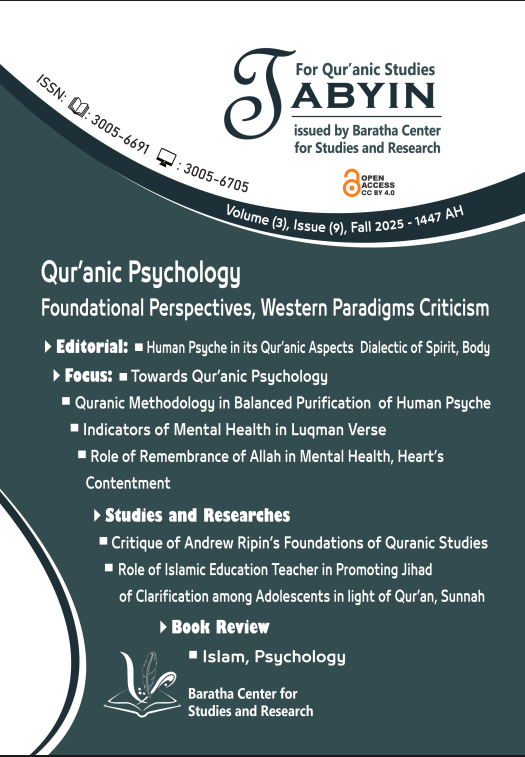
This expansion, despite its magnitude, led to a striking phenomenon: the proliferation and divergence of approaches rather than their convergence. Each school thought developed its own conception of the psyche and its methods of treatment, revealing the absence of a unified framework within which these theories could be tested and organized. This indicates that the field of psychology, despite its apparent progress, is still searching for a center to regulate its aspects. However, this expansion took place, for the most part, within specific philosophical frameworks that were historically formed within the course of Western modernity; where human was defined as a self closed off to his individual experience, and the relationship between the soul and the body was dismantled, and the psyche was defined by functional characteristics, linguistic structures, or neural processes.
We then highlighted the need to establish this science and endeavored to lay down the most important foundations and principles of Qur'anic psychology, such as monotheism, the inherent dignity of humankind, humanity's role as caliphate on Earth, and his capacity to choose freely between misguidance and guidance. Due to the limited scope of this study, we have focused on analyzing a single concept from the various concepts of this science, the psyche, in its different types, states, levels, and appellations as mentioned in the Qur'an.
We have also presented some examples of psychological functions that are specifically referenced in the Qur'an, without the influence of modern psychology, such as visions, divine inspiration, contemplation, and reflection.
It also highlights key points that help individuals purify their psyches by tracing Qur'anic verses that discuss the nature of the soul, how humans interact with it, and how one can either be among the successful or the misguided, according to the Qur'anic principles found in many chapters that address the fate of humanity.
Allah, Almighty created the human psyche and entrusted it with His care, charting for it the path of righteousness after providing detailed guidance within it, encompassing both good and evil. The critical points between these two paths clarify the way and illuminate the path, offering guidance on how to follow a balanced approach that purifies the human psyche in a comprehensive and clear manner.
In the first step, the article examines the concepts of health and mental health using foundational and bibliographic studies. It then presents indicators of mental health from the perspective of humanistic psychology, before identifying and analyzing the indicators of mental health in "Luqman" verse.
The results indicate that the religious concepts presented in "Luqman" verse have a direct impact on an individual's psychological and behavioral well-being. A comparison of mental health indicators in the Quran with Carl Rogers' humanistic psychology reveals significant similarities between these two sources. Based on this, adhering to the Quran's recommendations can reduce the occurrence of psychological disorders and guide individuals toward lasting peace in their personal and social lives.
In a reality suffering from spiritual emptiness and civilizational deviations, the need for remembrance becomes urgent, as it serves as a path to shaping a balanced Muslim individual, capable of contributing to the establishment of a righteous society and a just human civilization. In this way, the 'good life' promised by Allah to His believing servants is achieved, and both the individual and society are protected from falling into "depressed life".
He believed in several important issues within his Qur'anic studies, including the concept that the Qur'an was written two centuries after the passing of the Prophet Mohammad (peace be upon him), that the Qur'an was inspired by both the Hebrew and Christian scriptures, and was compiled in an environment characterized by sectarian conflicts. He also argued that it was influenced by the Mesopotamian civilization, and that some Qur'anic concepts, such as metaphor, were borrowed from these traditions. As a result, these ideas led Ripin to pursue a path of proving these foundational assumptions, which are evident in his writings, as discussed in this article.
The teacher must also possess a high level of persuasion, especially when addressing contemporary theological issues, confronting atheistic ideologies, and responding with clarity, conviction, and impact. The teacher should make dialogue the foundation of both the initiation and conclusion of any discussion, drawing upon the Quran and the Sunnah of the infallibles.
In the thought of Imam Khamenei, jihad of clarification [Jihad al-Tabyin] involves clarifying truths, correcting deviations, and confronting the intellectual arrows of the enemy, making any form of awareness raising a true intellectual jihad. This requires the teacher to have strong theological, behavioral, and communicative skills, along with a deep understanding of the psychological and social needs of adolescents. Additionally, the teacher must be equipped to address doubts and provide responses with wisdom and finesse.
The article highlights the importance of critical and creative thinking in the Quran and emphasizes the need to apply these skills in educational settings, enabling adolescents to become conscious, responsible individuals capable of resisting intellectual deviations. This would ultimately help them evolve into active contributors to the development of Islamic consciousness and identity.
In this context, the Islamic perspective emphasizes the balance between the intellect and desires in determining normal behavior. Human behavior is viewed through classifications that link psychological and intellectual aspects, including worship and moral conduct.
Regarding mental illnesses, Islam presents treatment through repentance and spiritual awareness, highlighting the importance of religious and spiritual factors in achieving psychological balance. In contrast, Western approaches rely on various therapeutic strategies, such as analytical and behavioral therapies, which focus on the psychological and social effects in treating disorders. The difference between the two perspectives is evident in their understanding of human nature and treatment, with the Islamic perspective seeking internal balance by stre



Comments